The front-window problem, and the one feature that solves it
You want the daylight and the view of the parkway trees. You do not want the whole street watching you eat dinner. Top-down/bottom-up is the answer we fit more than any other.
Nearly every older street in Lombard, Wheaton, Elmhurst and Downers Grove has the same geometry: the house sits close to the sidewalk, the best room in it faces the street, and the window in that room is both the reason you bought the house and the reason you keep the lamp off at night.
The instinct is to hang something you can open or close. The problem is that those are the only two states you get, and neither of them is what you want. Closed, the room goes dark in the middle of the afternoon. Open, you are on display.
Two rails, not one
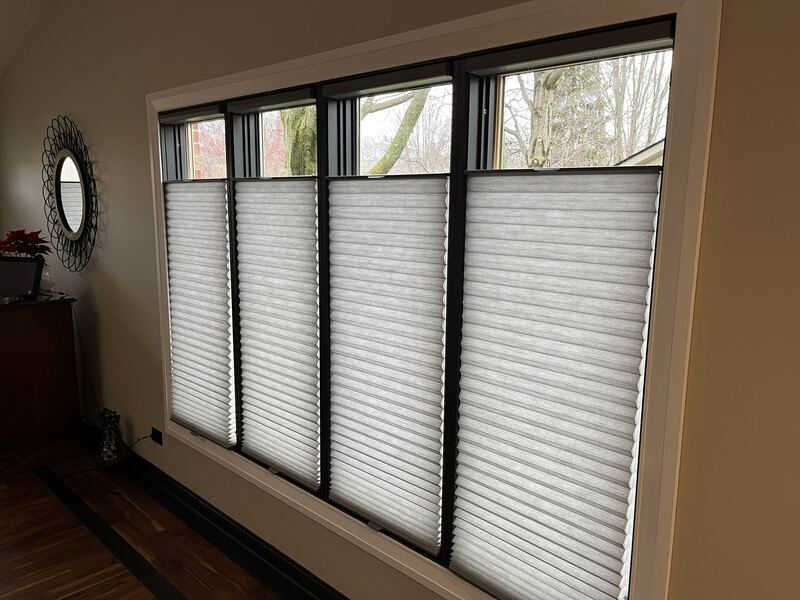
A top-down/bottom-up shade has two moving rails instead of one. Hunter Douglas describes the operation plainly: it works from the top down, bottom up, or in combination. In practice that means you can drop the shade from the top so daylight pours in over head height while the lower two thirds of the glass stays covered. Nobody on the sidewalk can see in. The room stays bright. You still see sky and treetops from the sofa.
It is a small mechanical idea that solves a problem almost nothing else solves cleanly, and it is the single most-requested configuration we install in the older parts of DuPage County.
Which products offer it
Top-down/bottom-up is available on cellular shades, Roman shades and woven wood shades, with manual or PowerView® operation depending on the product. The three we fit most often:
- Duette® Cellular Shades — the honeycomb construction insulates the glass at the same time, which matters in a hundred-year-old window.
- Applause® Cellular Shades — the same logic in an insulating double-cellular design, at a friendlier price.
- Vignette® Modern Roman Shades — where you want soft fabric folds rather than a pleated shade.
A practical note on fabric
People often reach for a room-darkening fabric here, reasoning that more privacy is better. Usually it is the wrong call for a front room. A light-filtering fabric gives you complete visual privacy during the day — nobody sees in through it — while keeping the room glowing. Save the room-darkening fabric for bedrooms, where you actually want the dark.
If you do want genuine blackout in a bedroom, ask about Duette® with LightLock®. It uses U-shaped side channels with specially shaped micro-ridges designed to absorb or deflect nearly all incoming light — a different category of darkness from a standard room-darkening shade.
What it costs you to find out
Nothing. We bring the samples to the room, hold them against the actual glass, and raise and lower them in your own light. Fifteen minutes with a sample in the window tells you more than an hour of looking at pictures.
Want this looked at in your own house?
The in-home consultation is free and there is no trip charge anywhere in our service area. Call (630) 871-2907 or send us a message.
Hang & Shine Inc — window treatment specialists serving twenty communities across Chicago’s western suburbs since 1998.