Shutters, shades or blinds? A straight answer for an older suburban home
Hinsdale Georgians, Elgin Victorians, Downers Grove kit houses and Wheaton foursquares all ask slightly different questions of a window treatment. Here is how we decide.
The western suburbs have unusually varied housing stock for one metropolitan area. Within a twenty-minute drive you can go from an 1890s Queen Anne in Elgin to a 1920s brick Georgian in Elmhurst to a 2015 two-storey great room in Naperville. The right window treatment is not the same in any two of them.
Here is roughly how we think about it on site.
Start with the trim, not the fabric
In an older house the millwork is usually the best thing in the room, and a window treatment either respects it or fights it. Deep original casings, a proper sill and a substantial apron can carry a shutter, which reads as architecture. Thin or painted-over trim generally cannot — a shutter there looks applied.
So the first question is not what you want on the window. It is what the window already is.
When shutters are right
Shutters make sense when the house has the weight to carry them and you intend to stay. They cost more than a shade and they last considerably longer, and because they are a fitted architectural element they tend to survive a sale as a feature rather than something the next owner rips out.
They are also the only product with a genuinely continuous middle setting. A shade is up, down, or somewhere in between. A shutter’s louvres tilt to any angle and hold it, which gives you far finer control over where light lands in the room.
Three lines, all with 2½", 3½" or 4½" louvres: Heritance® in 100% natural hardwood, for formal rooms and anywhere you want a stain; NewStyle® composite, which pairs the look of finely painted wood with composite durability; and Palm Beach™ polysatin, which is water resistant and carries the Palm Beach Promise™ against warping, cracking, fading, chipping, peeling and discolouring — the one for bathrooms and kitchens.
When shades are right
Shades win on three things: energy performance, softness, and price.
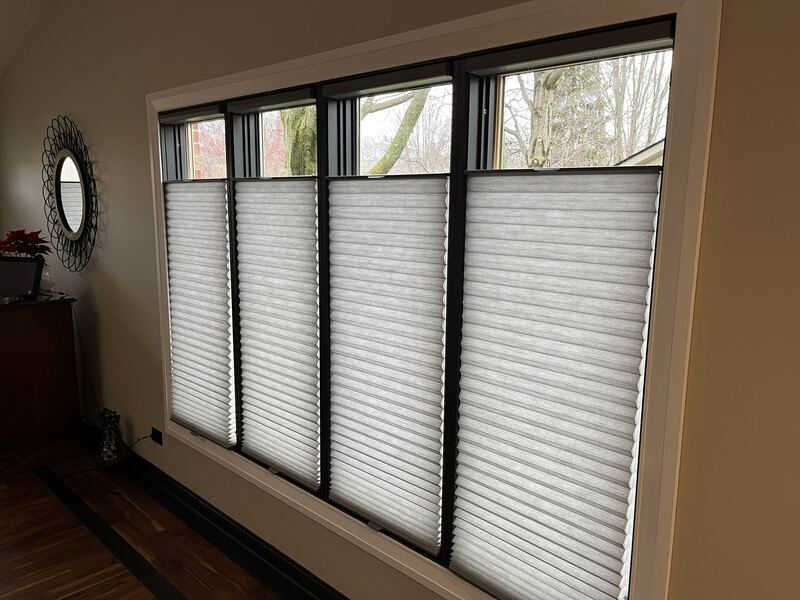
In a house with original or early replacement glazing — which is most pre-war housing around here — the window itself is doing very little thermally. A Duette® or Applause® cellular shade puts an insulating layer of trapped air directly against the glass, and it absorbs sound while it is there. For a cold north-facing bedroom in a 1925 bungalow, that is a more useful intervention than anything decorative.
If the room wants warmth and texture rather than crispness, Provenance® woven woods — handcrafted from wood, reeds, grasses and bamboo — sit beautifully in older interiors, and can take an independent operable liner behind them so you get texture by day and privacy by night from one headrail.
And if you want to keep the view: Silhouette® and Pirouette® sheer shadings suspend fabric vanes against sheer facings, so tilting them gives you daytime privacy and diffused light without blocking the window.
When blinds are right
Blinds get unfairly dismissed. A real basswood Parkland® blind in a 2½" slat, stained to pick up the floor, is entirely at home in a period house and costs well under a shutter. EverWood® faux wood goes where real wood should not — bathrooms, kitchens, sunrooms — with Performance Plus™ protection against fading, discolouring, warping and bowing for the life of the blind.
The windows that decide for you
Some openings narrow the field by themselves:
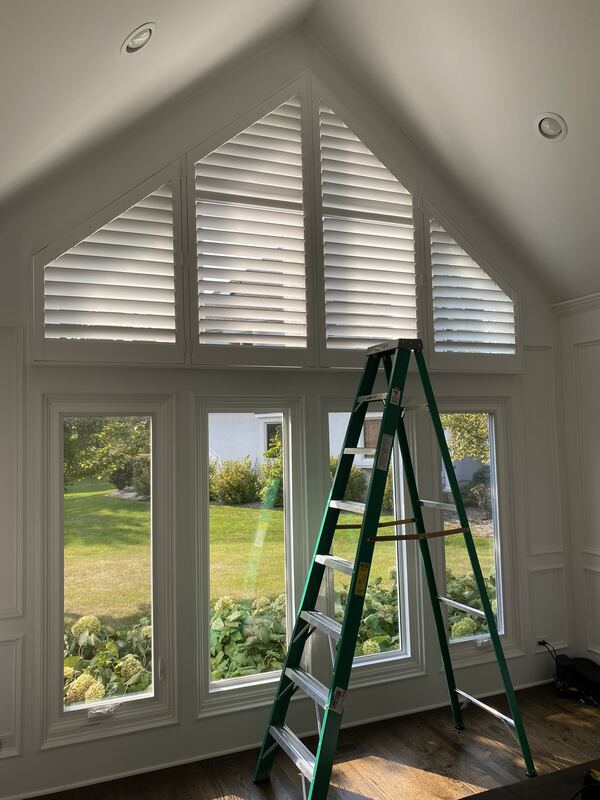
- Arches and angles — specialty-shape shutters, or a cellular shade fabricated to the curve. A true half-round is usually a fixed piece; angled tops can often be made operable.
- Sliding patio doors — a cordless Vertiglide™ cellular system, Luminette® sheer panels, or panel-track blinds.
- Doors with handles in the way — shutters built with a cut-out shaped to the hardware.
- Entry sidelights — slim cordless operable shades, so nothing dangles at head height.
- Two-storey great rooms — motorise them. PowerView® Gen 3 runs by app, remote, voice or schedule, and the internal rechargeable battery recharges from below by magnetic connector.
The honest version
There is no universally correct answer, and anyone who gives you one without looking at your rooms is selling rather than advising. Most houses we work in end up with a mix: shutters in the front rooms where they read as architecture, cellular shades in the bedrooms where comfort matters more than looks, and something specific on whichever opening is the awkward one.
That mix is easier to arrive at with samples in your hand, in your room, at the time of day you actually use it. Which is the whole reason we do not have a showroom.
Want this looked at in your own house?
The in-home consultation is free and there is no trip charge anywhere in our service area. Call (630) 871-2907 or send us a message.
Hang & Shine Inc — window treatment specialists serving twenty communities across Chicago’s western suburbs since 1998.